Books by Robin Heath
We now have signed copies of
Temple in the Hills, and Bluestone Magic. All orders made now of these titles will receive a signed copy. Limited stock.
A Selection of Books by Robin Heath an internationally published author on the subject of ancient science, he is well known and widely respected on the UK lecture circuit
(including the Summer Lectures) and has recently been awarded an Honorary Research Fellowship within the Department of Archaeology and Anthropology at the University of Wales, Lampeter.
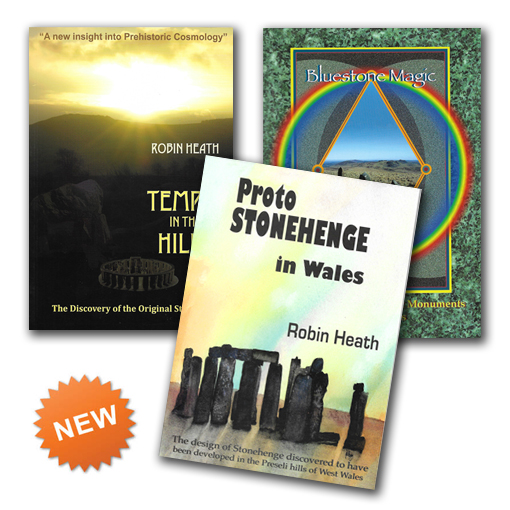
TEMPLE IN THE HILLS: The Discovery of the Original Stonehenge
The current model of the prehistoric world overlooks (or ignores) several cultural components that author and presenter Robin Heath demonstrates were known about and available to the Neolithic megalith builders. Over the past thirty years, the author has rediscovered these components through extensive research into
prehistoric monuments within their sacred landscapes. Heath now reveals that the design for Stonehenge originated in the ‘bluestone country’ of the Preseli hills, in West Wales.
PROTO STONEHENGE: The design of Stonehenge discovered to have been developed in the Presell hills of West
Wales
In the Preseli mountains of coastal West Wales, volcanic outcrops have been long identified as the source of many of the bluestone megaliths at Stonehenge. Now, following the recent discovery of a previously unknown megalithic complex, a second connection is made between Wales and Stonehenge,
showing that Stonehenge was the end result of a long project undertaken over many centuries with the goal of developing a Neolithic technology capable of measuring and recording time and space.
BLUESTONE MAGIC: A Guide to the Prehistoric Monuments of West Wales
Welcome to Bluestone Country! The largely ruinous collection of dolmens, standing stones, stone rows and circles scattered over the Preseli landscape seems not to have anything to say to us today. The megalithic imprint on the land appears to have no bearing on modern life. Archaeologists have catalogued and dated the
monuments over the past few centuries, but the big questions remain unanswered: why were so many megalithic structures built and what were they for? why were they located where they were?